

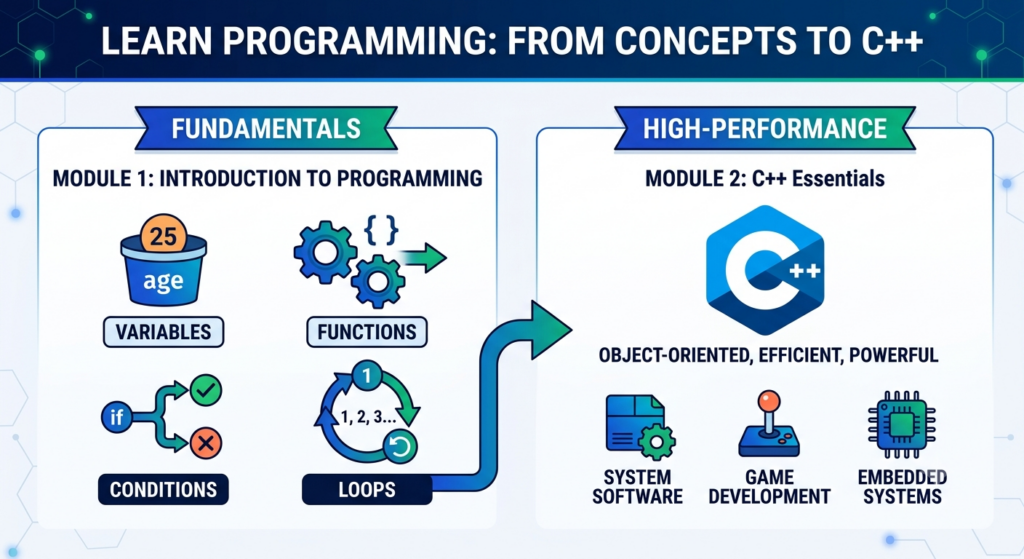
Introduction
Computer programming is the engine driving today’s digital architecture. From mobile apps and artificial intelligence to web browsers and video games, software solutions are built on logical constructs. Regardless of the programming language you choose, fundamental concepts remain universal across the computing landscape.
In this comprehensive tutorial, Module 1 covers universal programming concepts, while Module 2 provides an entry-level technical overview of C++.
MODULE 1: Introduction to Programming
1.1. What is Programming?
Programming is the process of writing instructions (algorithms) that tell a computer how to perform a specific task or solve a problem. Since computers operate purely on binary logic (0s and 1s), programming bridges human problem-solving with machine execution.
1.2. Low-Level vs. High-Level Languages
Computer languages are generally divided into two main categories based on abstraction:
- Low-Level Languages: These include Machine Code and Assembly Language. They interact directly with hardware components. While low-level code executes with minimal latency, it is difficult to read, write, and maintain.
- High-Level Languages: Examples include Python, C++, Java, and C#. These languages use human-readable syntax (mostly in English). Compilers or interpreters translate high-level code into machine instructions before execution.
1.3. Programming vs. Scripting Languages
Understanding the distinction between programming and scripting languages depends heavily on how code is executed:
- Programming Languages (Compiled): Languages like C, C++, and Rust require a compiler to translate the entire source code into binary executable files before running. They are typically used for high-performance software and operating systems.
- Scripting Languages (Interpreted): Languages like JavaScript, Python, and Bash use an interpreter to read and execute code line-by-line at runtime. They are ideal for task automation, web scripting, and quick development cycles.
1.4. Fundamental Constructs of Programming
Regardless of the syntax, almost every high-level programming language uses five primary constructs:
1.4.1. Variables
Variables act as named memory containers in system RAM used to hold data (such as numbers, text, or true/false values) that can be accessed or modified during program execution.
1.4.2. Functions
Functions are modular, reusable blocks of code designed to perform a specific action. They promote clean code structure by following the DRY (Don’t Repeat Yourself) principle.
1.4.3. Conditional Statements
Conditional statements (if, else if, else, switch) introduce decision-making capabilities to software. They execute specific code blocks depending on whether a given condition evaluates to true or false.
1.4.4. Loops
Loops (for, while, do-while) allow code blocks to execute repeatedly until a stopping condition is met. They handle bulk data operations and repetitive operations efficiently.
1.4.5. Understanding the Code
Code comprehension involves reading syntax, analyzing control flow, tracing variable states, and discovering logic bugs. Developing strong code comprehension skills is vital for debugging and collaboration.
1.5. Conclusion of Module 1
Learning syntax is only part of software engineering; mastering computational logic is the core requirement. Once you understand variables, functions, conditions, and loops, transitioning between different languages (like Python, JavaScript, or C++) becomes straightforward.
MODULE 2: C++ Essentials
Overview of C++
C++ is an industry-standard, general-purpose, object-oriented programming language developed by Bjarne Stroustrup as an extension of the C language. It provides fine-grained control over system memory while offering high-level architectural constructs.
Primary Use Cases for C++
- Game Engines: Core engines like Unreal Engine are built with C++ because game development requires fast rendering speeds and low latency.
- System & OS Development: Key subsystems of OS platforms (Windows, macOS, Linux) and high-performance databases (MySQL) are written in C++.
- Competitive Programming: Due to fast execution times and a rich Standard Template Library (STL), C++ is widely preferred in algorithmic competitions.
- Embedded Systems & Robotics: Microcontrollers, automotive software, and IoT devices rely on C++ for direct hardware manipulation.
Code Example: Putting Core Concepts Together in C++
include
using namespace std;
int main() {
// 1. Variable
int totalCount = 5;
cout << "=== Loop and Conditional Test ===" << endl;

// 2. Loop
for (int i = 1; i <= totalCount; i++) {
    // 3. Conditional Statement
    if (i % 2 == 0) {
        cout << "Number " << i << " is Even" << endl;
    } else {
        cout << "Number " << i << " is Odd" << endl;
    }
}

return 0;
}


Leave a Reply