

ing Fundamentals: A Complete Guide to Logic, C++, and Python for Cyber Security
Programming often feels intimidating when you first step into it. With so many languages, frameworks, and syntax rules, beginners frequently wonder: Where do I actually start?
The truth is that every programming language shares a common foundation. Once you understand the core mechanics of how computers execute instructions, picking up new languages becomes significantly easier.
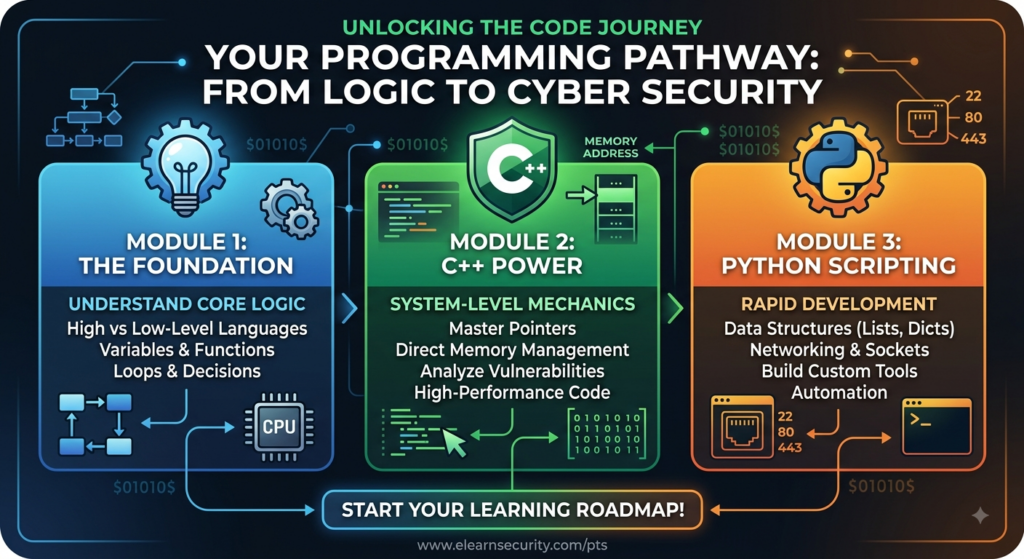
In this comprehensive guide, we will break down the essential journey of a developer and security engineer into three core phases:
The Universal Foundations of Programming
Deep-Dive into System-Level Mechanics with C++
Automating Real-World Security Tools with Python
Let’s dive in.
Module 1: Universal Foundations of Programming
Before writing complex applications or analyzing software vulnerabilities, you must understand how human intent translates into machine execution.
1. Low-Level vs. High-Level Languages
Computers do not natively understand English, Bangla, or C++. They only process binary logic (0 and 1).
Low-Level Languages (Assembly / Machine Code): These languages speak almost directly to the computer’s CPU. They offer extreme speed and precise hardware control, but writing them is slow and error-prone for humans.
High-Level Languages (Python, C++, Java): These languages use human-readable syntax. They rely on an Interpreter or Compiler to translate your code into binary instructions that the processor can run.
Analogy: Imagine ordering food at a restaurant in France. If you speak fluent French, the chef understands you immediately (Low-Level). If you speak English, an interpreter must translate your order into French first (High-Level).
2. The Core Building Blocks
Regardless of the language you choose, these four concepts exist everywhere:
Variables: Storage containers in memory that hold data. Think of a variable as a labeled cardboard box where you store items like user IDs, passwords, or numbers.
Functions: Reusable blocks of code that perform a specific task. Think of a function as a blender: you supply inputs (fruit and milk), it runs a process, and it delivers an output (a smoothie).
Conditional Statements (if/else): Logic gates that allow your program to make decisions.
Example: If a user enters the correct password, grant access; Else, display an error message.
Loops (for/while): Constructs that repeat an action until a specific condition is met.
Example: Keep checking a network port until a connection is established.
Module 2: Low-Level Power and Memory Management with C++
Once you grasp basic logic, C++ introduces you to how software interacts with actual physical memory (RAM). C++ gives developers granular control over system resources, making it the industry standard for high-performance software, game engines, and security research.
1. Understanding Memory and Pointers
In high-level languages like Python, memory is managed automatically. In C++, you manage the memory. This brings us to one of the most critical concepts in C++: Pointers.
A standard variable stores a value.
A Pointer stores the memory address where that value lives in RAM.
#include <iostream>
using namespace std;
int main() {
int secretCode = 1337;
int* ptr = &secretCode; // ‘ptr’ holds the memory address of secretCode
cout << “Value: ” << secretCode << endl;
cout << “Memory Address: ” << ptr << endl;
return 0;
}
Analogy: Instead of handing your friend a physical book, you hand them a piece of paper with the exact shelf location and address of where the book is stored in a library. That paper is a pointer.
2. Why C++ Matters for Exploitation Analysis
Because C++ allows direct memory access through pointers and arrays, improper memory handling can lead to vulnerabilities like Buffer Overflows. Understanding C++ enables security professionals to analyze how malicious code alters memory spaces and build resilient, secure software.
Module 3: Rapid Scripting and Automation with Python
While C++ gives you low-level control, Python gives you speed of development. Python is clean, readable, and incredibly versatile, making it the go-to language for automation, data analysis, and security scripting.
1. Key Data Structures in Python
Python simplifies data handling with built-in data structures:
Lists: Ordered, mutable sequences of elements (like a shopping list).
Dictionaries: Key-value pairs that allow instant data lookup (like a phonebook matching a name to a phone number).
# Python Dictionary Example
target_server = {
“ip”: “192.168.1.1”,
“status”: “active”,
“open_ports”: [22, 80, 443]
}
print(target_server[“ip”]) # Output: 192.168.1.1
2. Practical Scripting for Network Tools
Python excels at network communications via its native socket library. With just a few lines of code, you can build custom tools like a basic Port Scanner to check active network services:
import socket
target = “127.0.0.1”
port = 80
# Create a socket object
s = socket.socket(socket.AF_INET, socket.SOCK_STREAM)
s.settimeout(2)
result = s.connect_ex((target, port))
if result == 0:
print(f”Port {port} is OPEN”)
else:
print(f”Port {port} is CLOSED”)
s.close()
Conclusion
Mastering software development isn’t about memorizing syntax for twenty different languages—it is about understanding system architecture and problem-solving.
Start with fundamental logic to build a strong problem-solving mindset.
Learn C++ to understand low-level operations, memory layout, and execution speed.
Master Python to automate repetitive tasks, build custom tools, and analyze complex systems rapidly.
By combining these skill sets, you build a foundation that translates directly into real-world software engineering and security auditing.


Leave a Reply