

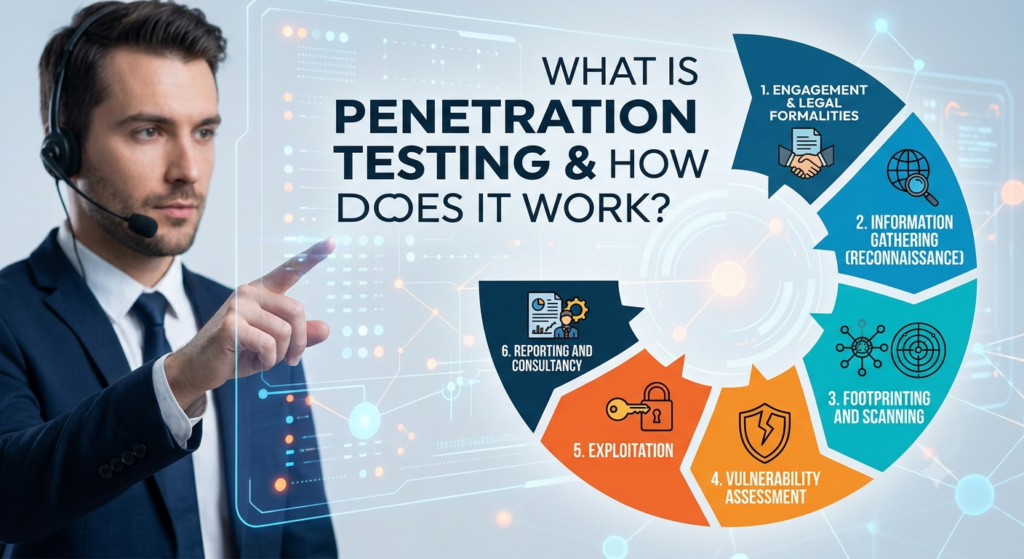
What is penetration testing, why is it vital, and how do professional penetration testers conduct an assessment step-by-step? Learn everything in this comprehensive guide.
In today’s digital era, maintaining information security is one of the most critical challenges for any business or enterprise. Every single day, thousands of websites and network infrastructures fall victim to cyberattacks. But the core question remains: How can we measure our system’s defenses before a real attacker strikes?
This is precisely where Penetration Testing (commonly known as a Pentest) becomes essential.
Penetration testing is an authorized, simulated cyberattack performed on a computer system, web application, or network to evaluate its security posture and identify exploitable vulnerabilities. Simply put, it is the proactive practice of finding and fixing security flaws in your own systems before malicious hackers can exploit them.
However, professional pentesting is far more than just launching automated tools to compromise a target. What separates an amateur script-kiddie from a seasoned security professional is their skill set and adherence to a structured methodology.
Below is a detailed breakdown of the complete lifecycle of a professional penetration testing engagement, spanning from initial scoping to final reporting.
The Complete Penetration Testing Lifecycle
A professional penetration testing engagement is typically executed across six distinct phases:
[1. Engagement] ➔ [2. Information Gathering] ➔ [3. Footprinting & Scanning]
│
[6. Reporting & Consultancy] ◄─ [5. Exploitation] ◄─ [4. Vulnerability Assessment]
Phase 1: Engagement & Legal Formalities
The foundational rule of penetration testing is obtaining explicit, legal consent. Testing any network or web application without formal authorization is illegal. Key activities in this phase include:
- Quotation: The security firm evaluates the project scope and provides an estimated budget to the client.
- Proposal Submittal: A comprehensive proposal is submitted outlining the testing methodology, tools to be utilized, deliverables, and estimated timeline.
- Defining the Scope (Staying in Scope): The boundaries of the assessment are strictly established. For instance, if a client explicitly authorizes testing on api.example.com, attempting to attack the main domain example.com is out of scope and constitutes unauthorized access.
- Incident Handling: Procedures are established to quickly recover systems and notify stakeholders in the event that an active test unexpectedly disrupts production services.
- Legal Agreements & NDA: Non-Disclosure Agreements (NDAs) and formal contracts are signed to protect proprietary data and establish legal authorization (often called the “Get-Out-of-Jail-Free card”).
Phase 2: Information Gathering (Reconnaissance)
Before launching any direct attacks, testers gather as much context and public intelligence about the target as possible.
- General Information: Collecting domain names, IP address ranges, WHOIS data, and server locations.
- Understanding the Business: Analyzing the client’s business model to identify high-value assets. For instance, securing payment processing workflows in an e-commerce platform takes precedence over public static pages.
- Infrastructure Reconnaissance: Identifying whether the target relies on cloud service providers (AWS, GCP, Azure) or local on-premise infrastructure.
- Web Application Profiling: Mapping out underlying tech stacks, programming languages, CMS frameworks (WordPress, Drupal), and client-side scripts.
Phase 3: Footprinting and Scanning
In this phase, testers actively scan the target infrastructure to map out active systems and network topologies.
- OS Fingerprinting: Identifying whether target servers are running Linux, Windows, or Unix derivatives, as each operating system presents distinct attack vectors.
- Port Scanning: Network ports act as entryways. Using tools like Nmap, testers scan for open ports (e.g., Port 80 for HTTP, Port 443 for HTTPS, Port 21 for FTP).
- Service Detection: Identifying specific software applications and exact version numbers running on open ports (e.g., Apache 2.4.41 or Nginx 1.18.0).
Phase 4: Vulnerability Assessment
Testers correlate the information gathered during scanning against known security flaw databases (such as the CVE database) to identify potential misconfigurations or unpatched software bugs.
Example: If service detection reveals that a server is running Apache 2.4.41, the tester checks public threat intelligence sources to determine whether that specific version suffers from known Remote Code Execution (RCE) or Privilege Escalation vulnerabilities.
Phase 5: Exploitation
During exploitation, testers attempt to safely exploit the identified vulnerabilities to confirm their presence and determine the potential impact of a real attack.
If a web application is vulnerable to SQL Injection or Arbitrary File Upload, testers execute controlled Proof-of-Concept (PoC) exploits to demonstrate unauthorized database access or server control. Professional testers ensure no data is corrupted or services destroyed during this process.
Phase 6: Reporting and Consultancy
The primary deliverable of a penetration test is a comprehensive, actionable report detailing the security findings.
A professional pentest report includes two core sections:
- Executive Summary: Designed for non-technical leadership (CEOs, CISOs, Management). It summarizes overall business risks, high-level findings, and risk levels using charts and intuitive metrics.
- Technical Details: Written specifically for developers and sysadmins. It outlines exact endpoints, steps to reproduce each vulnerability, Proof-of-Concept code, and precise remediation (patching) instructions.
Following report delivery, security teams provide consultancy meetings to assist the client’s internal IT/development teams in remediation, followed by a re-test to verify that all patches were applied effectively.
The Secret to an Effective Penetration Test
A common misconception is that running automated vulnerability scanners (like Nessus or Acunetix) and exporting a PDF equals a penetration test. This is far from true.
The secrets to delivering an effective pentest lie in:
- Manual Testing Focus: Automated scanners catch only 30–40% of vulnerabilities. Critical flaws like Business Logic Flaws, Insecure Direct Object References (IDOR), and complex Authentication Bypasses require manual human analysis.
- Adhering to Industry Frameworks: Following recognized methodologies such as OWASP Top 10, PTES (Penetration Testing Execution Standard), and NIST SP 800-115.
- Adopting an Attacker’s Mindset: Thinking beyond automated rules to anticipate how an actual threat actor would chain minor vulnerabilities together to compromise the entire system.
Conclusion
Penetration testing is not merely about breaking into systems; it is a structured, legal, and professional discipline aimed at fortifying digital assets. By combining methodology, technical expertise, and manual analysis, penetration testing provides organizations with the actionable insights needed to stay one step ahead of cyber adversaries.


Leave a Reply